Historic Southwest heat wave has shades of record-blasting June 2021 Northwest event
 Scott Sistek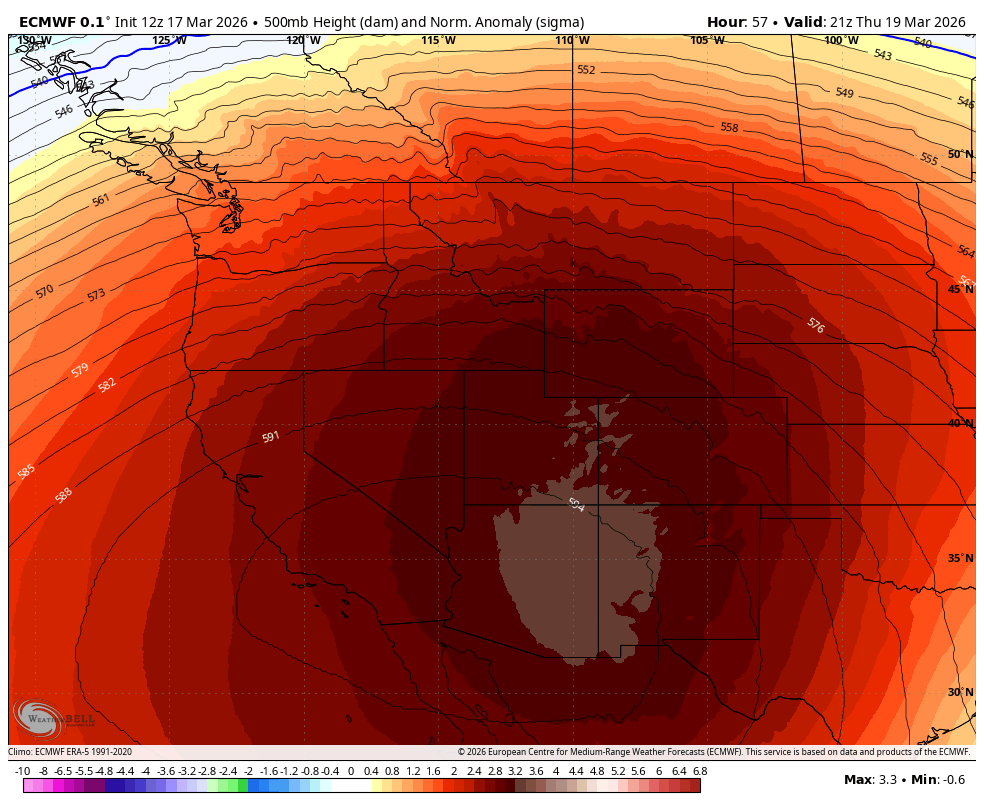
500 mb heights chart showing massive heat anomaly over the Desert Southwest this week
You may have heard that the Southwestern U.S. is undergoing a historic heat wave this week that is looking like no ordinary heat wave. In fact, it has similarities to the record-smashing heat event we endured here in the Pacific Northwest in late June of 2021 when Seattle broke 100 on three consecutive days, culminating with a 108-degree high. Other spots around Western Washington reached 110!
And while this ridge is too far away to bring any direct heat-related impacts to Seattle and the Northwest, it could have some indirect impacts that could affect our area down the line by priming the region for a very early wildfire season.
First the setup: A massive ridge of high pressure known as a “heat dome” is building across the Southwest and it’s expected to last for multiple days this week and into the weekend.
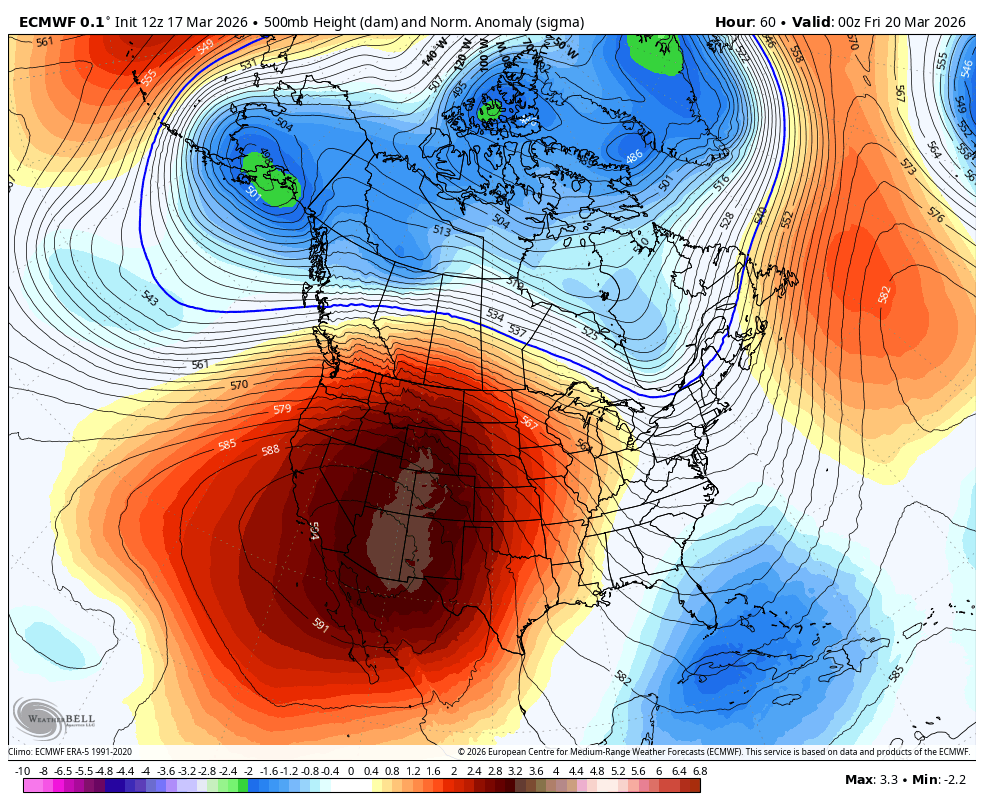
But this is no ordinary heat dome. By intensity, it is looking like the strongest and hottest ridge on record for the U.S. for this time of year — and it’s not even close. “Shattering” the record is an understatement; “obliterated” might be closer.
“The seasonal anomalousness, as well sheer spatial extent, of upcoming record-shattering Western U.S. heatwave is genuinely startling. This will be associated with, by far, the strongest ridge ever observed during (at least) any Nov-Mar month,” noted California climatologist Dr. Daniel Swain posted on X this week. “In fact, this will approach the Jun 2021 PacNW/BC heat event in terms of meteorological anomalousness (though not, fortunately, in terms of absolute surface temperatures. It is still *March*, after all!)”
How hot will it get? Parts of California, Arizona, Nevada and New Mexico are not only looking at breaking all-time March heat records — by multiple degrees across multiple days — but they might actually best all-time April heat records.
For example, Phoenix, whose records go back to 1933, has reached 100 degrees in March just once — on March 26, 1988. Their forecast is expected to reach or exceed 100 for the next SIX DAYS. Thursday’s forecast high is 105. Friday and Saturday’s forecasted highs are both 107! Phoenix’s all-time APRIL record is… 105.
Put another way, at this moment, Phoenix had never reached 107 degrees in a year until May 5th.
Las Vegas? March record high is 93. Next 7 days: 92-98 (Vegas has not reached 100 before May before)
Los Angeles: March record high: 99. Forecast: 94-98 through Saturday.
San Francisco area: Oakland March record: 86. Next four days: 91-92
San Jose: 91-93 next four days. March record: 89
I could go on.
(For perspective, with some areas getting 25-30 degrees above average, that would be akin to Seattle reaching the mid 80s this week.)
This week’s heat from the West Coast to the Plains will set hundreds of daily records—many by several degrees. Some areas may even set March records, with temperatures more typical of June.
Learn how to stay safe: https://t.co/asAP108BNk pic.twitter.com/ijzYfEV9N4— National Weather Service (@NWS) March 17, 2026
Now you might look at those desert numbers and think: Sure, wrong season, but those temperatures are rather common for those areas in the summer so, unlike the mostly air-conditionless Northwest, they can handle that heat, right?
Yes in the sense that 95-105 in July is no big deal in the Southwest, though forecasters are sounding the alarm that many people won’t be acclimated to the sudden summer burst of heat as opposed to the usual gradual climb to get there.
It is a saving grace that, as Swain noted, this heat wave is happening in March when we’re not at full sun power. Had this been happening in June or July the temperatures we could be seeing across the SW could have been state records and you wonder if Death Valley could have topped its world record 130 degree day.
MELTING SNOW COULD CAUSE SOME BIG PROBLEMS LATER
While getting into A/C can help people get through the heat wave in the short term, one of the most concerning impacts from such an early season and anomalously intense heat wave is its effects on the region’s snowpack — already at near record low levels from the warm winter across the West.
“Western snowpack… will plummet at an unprecedented pace,” Swain said.
Swain noted that March is the time when California and the Southwest usually get some late season snow to start their defense against water shortages and wildfires issues in the spring and summer. This March is going the total opposite with such an intense hot and dry month. It could mean both increased risks of wildfires and water shortages.
In fact, this will approach the Jun 2021 PacNW/BC heat event in terms of meteorological anomalousness (though not, fortunately, in terms of absolute surface temperatures. It is still *March*, after all!) Western snowpack, however, will plummet at an unprecedented pace. pic.twitter.com/W3tsRhWlvv
— Daniel Swain (@Weather_West) March 15, 2026
“I expect an early and intense start to fire season in the Four Corners region especially, later expanding into most of the Western U.S. higher elevation forested regions,” Swain wrote in his Weather West blog earlier this week. “This was already the case due to very low snowpack and a record warm winter as of early March, but given the outlook for a 10-14 day period of exceptional heat and dryness to come and the prospect of record-low snowpack synchronized across multiple regions, that further elevates my level of concern regarding the potential for greatly elevated fire risk later this summer especially in forested settings at higher elevations and especially before the summer monsoon arrives. I do think we could see a much more active higher elevation forest fire season across the U.S. West this summer compared to the last few years, during which fire conditions in these settings have been much milder.”
And of course even if Washington or the Northwest isn’t directly under the snow-melting dome this week, we could feel the effects from an early head start and longer wildfire season across the West by getting more frequent bouts of imported smoke anytime the winds shift to the south or southeast.
Let’s hope the heat doesn’t turn out to be as intense, but the confidence is very high in a historic and extended heat event that will even eventually spread farther east across the Rockies and into the western Plains.